
When the Battlefield Extends Beyond the Front Line
In recent days, many people have been discussing Ukrainian drone strikes on Moscow and the Moscow Oil Refinery.

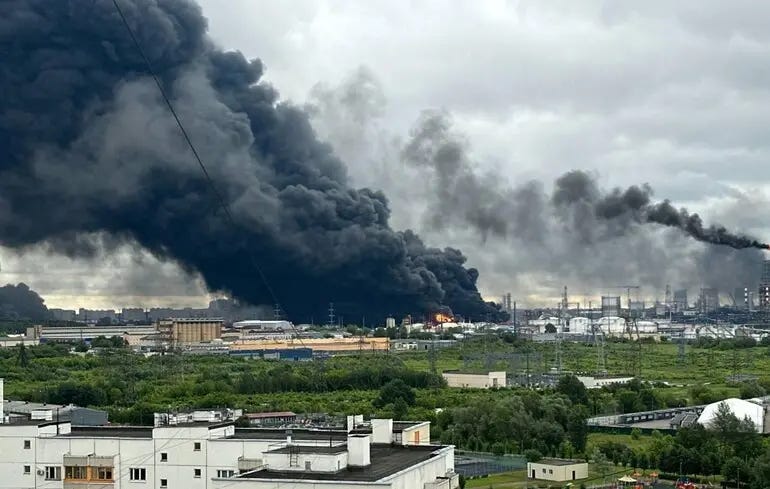
But the most interesting aspect of this story is not the specific target.
We are witnessing a much more important process.
The battlefield is gradually extending far beyond the front line.
Just a few years ago, war was associated primarily with trenches, artillery, and the advance of troops on the ground.
Today, the situation is changing.
Oil refineries, airfields, warehouses, logistics hubs, and military-industrial facilities are becoming part of the battlefield regardless of how far they are located from the line of contact.
When the Ground Slows Down, the Importance of Air Increases
Recent months have shown that achieving major breakthroughs on the ground is becoming increasingly difficult and costly.
Both sides have built deeply layered defenses and actively use drones, surveillance systems, and minefields.
Against this backdrop, the importance of long-range strikes continues to grow.
And this is no longer just about missiles or aviation.
Unmanned systems of various classes are beginning to play an increasingly important role.
In essence, part of the struggle is gradually shifting into the air and deep into the rear.
From Individual Drones to Complex Operations
This, in my view, is where the main conclusion of the recent attacks lies.
Not long ago, most discussions focused on specific drone models.
Which drone?
What range?
What warhead?
Today, the situation is beginning to change.
Judging by publicly available materials, recent attacks may have involved different types of UAVs with different characteristics, speeds, and missions.
But ultimately, the result was a single, coordinated operation.
If this trend continues, we may be witnessing a transition from individual platforms to more complex combined operations.
Another point is equally interesting.
Perhaps the main change is not the appearance of new drones.
But the fact that Ukraine is gradually moving from individual platforms to the systematic use of many different solutions simultaneously.
Different characteristics.
Different manufacturers.
Different approaches.
One operation.
The Illusion of an Impenetrable Sky
For a long time, Moscow was perceived as one of the most heavily protected areas in Russia.
However, recent events have highlighted an important reality.
The number of air defense systems and resilience against complex mass attacks are not always the same thing.
Especially when a system is confronted with a large number of targets with different characteristics.
And this challenge is not limited to Russia.
After several years of living under constant drone and missile attacks, Ukraine has been forced to develop its own approaches to defense.
I previously wrote about one such example in my article “The Sound, “which explored an acoustic drone detection system.
Another example is the concept of critical infrastructure protection and private air defense, which I discussed in my article “Perimeter.”
Today, it is becoming increasingly clear that large-scale and diverse drone attacks are gradually turning into a challenge for any modern air defense system.
Instead of a Conclusion
At first glance, this was just another long-range drone attack.
But if we look a little wider, something else becomes visible.
We are seeing fewer and fewer isolated strikes.
And more and more complex operations in which dozens of people, technologies, and decisions come together into a single action.
Perhaps this is what the next stage of this war looks like.
This blog is gradually gaining momentum.
If you enjoy this kind of analysis, you can support my work by becoming a paid subscriber or buying me a coffee.
Your support helps me spend more time researching, writing, and publishing new articles.
Thank you for reading.
Great 👍
Thanks