
Planet Under Stress

From Ukraine to Iran, the global system is being tested in real time.
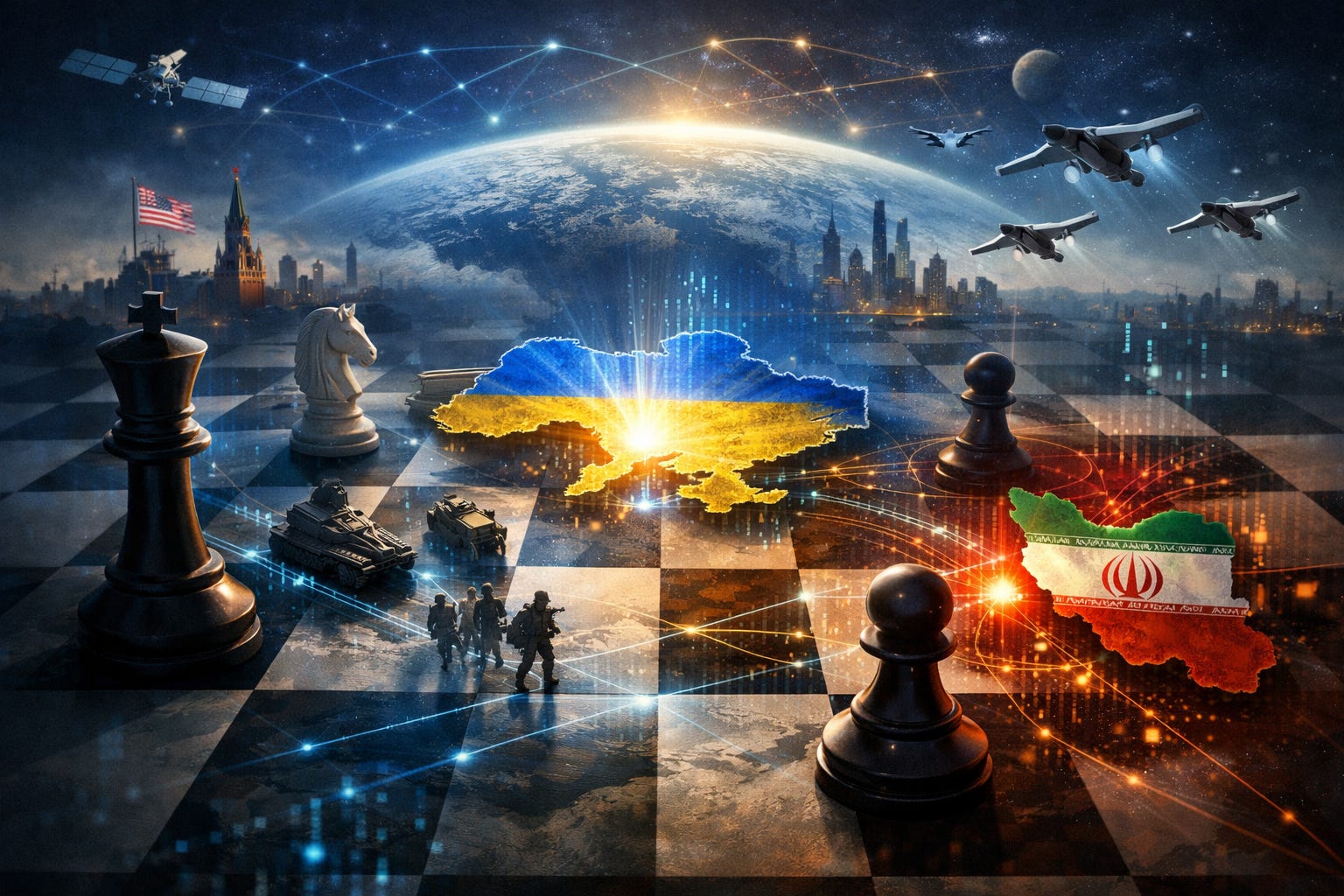
The world right now looks a bit like a giant chessboard where several games are being played at the same time. What’s happening around Iran is one of those games. To understand how it connects to Ukraine, it helps to zoom out from daily headlines and look at the deeper structural forces.
First layer: Iran is not just a Middle Eastern story. It’s one of the pressure points in the broader competition between global power systems. On one side you have the U.S. and its alliance network. On another, rising powers like China expanding economic influence. And then there’s a group of states challenging the current international order — where Russia and Iran often align strategically, even if they’re not formal allies.
Now the Ukrainian connection becomes clearer.
Since the full-scale invasion, Iran has effectively become part of Russia’s military supply chain. The most visible example is the loitering drone Shahed-136, used by Russia under the name “Geran.” This isn’t just a weapon transfer; it’s a technological corridor. Ukraine has become the battlefield where these systems are tested, adapted, and scaled.
Step back even further and something historically unusual appears: several geopolitical stress points are unfolding at the same time.
• Ukraine
• The Middle East
• The Taiwan question
Different regions, but the same underlying phenomenon — testing the limits of power and deterrence. In international relations this is sometimes called a system stress test: multiple shocks probing how resilient the global order actually is.
For Ukraine, events around Iran can influence things in several ways.
First, attention and resources. If a major escalation occurs in the Middle East, political focus and military resources from the U.S. and Europe inevitably shift. Great powers historically struggle to manage multiple major crises simultaneously.
Second, technological evolution. Iran has invested heavily in asymmetric warfare — relatively cheap drones, missiles, and swarm tactics. That happens to be the exact kind of warfare evolving in Ukraine right now: networks of sensors, mass drones, algorithm-driven targeting, and rapid battlefield iteration.
Third, the energy chessboard. Iran sits near the Strait of Hormuz, one of the world’s most critical oil arteries. Instability there can affect global energy prices, which ripple into European economies and indirectly influence their capacity to fund defense and support Ukraine.
There’s also a deeper layer that rarely appears in daily news.
Ukraine has unintentionally become a laboratory for the future of warfare. Drones, AI-assisted reconnaissance, distributed intelligence networks, crowdsourced innovation — these things are evolving faster on this battlefield than inside most traditional military systems. Countries across the world, including Iran, are studying it closely.
That creates a strange paradox: the wars are local, but the technological learning is global.
History sometimes moves in jumps. The World War I began as a regional crisis in the Balkans and expanded rapidly. That isn’t a prediction — just a reminder that geopolitical systems can shift faster than they appear to.
From a cold analytical perspective, Ukraine now sits near the center of a transitional era. The old international order is clearly under strain, while the new one hasn’t fully formed yet. Developments around Iran are simply another pressure line in that larger transformation.
Perhaps the strangest aspect of this era is that wars are now being studied, simulated, and optimized in near real time by algorithms and AI systems. Historians may eventually describe the 2020s as the decade when technology began to reshape not just weapons — but the logic of conflict itself.
Support the author:
https://ko-fi.com/antonovai